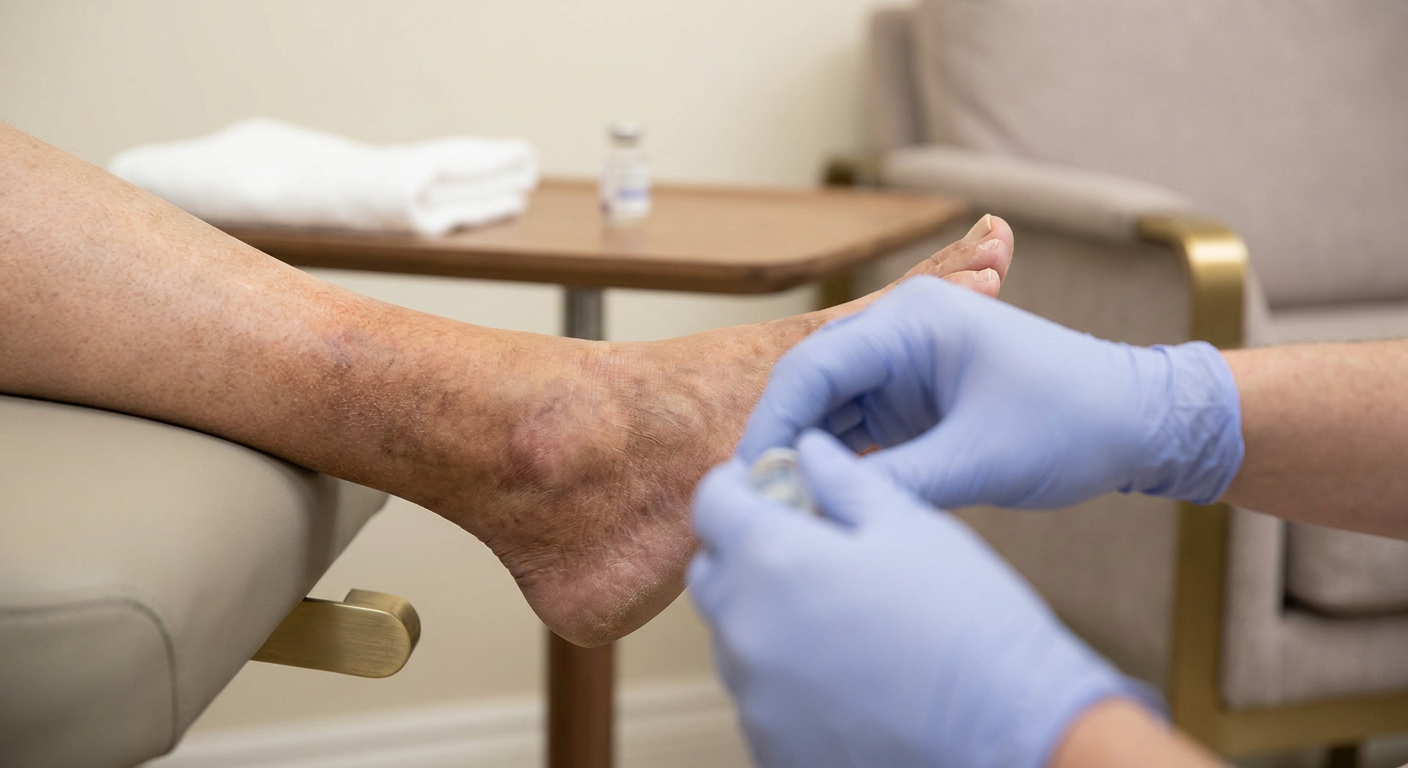
What is venous stasis dermatitis?
Venous stasis dermatitis is a skin change on the lower legs that develops when weak or damaged leg veins let blood and fluid pool near the ankles. Treating the underlying vein problem is the key to calming the rash and protecting the skin.
Quick answer
Venous stasis dermatitis (also called gravitational or stasis eczema) is inflammation of the skin on the lower legs caused by chronic venous insufficiency. When leg veins cannot move blood back to the heart efficiently, pressure and fluid build up in the tissue, leading to itching, redness, brown discoloration, and scaling around the ankles. It is a sign of an underlying vein problem and can be evaluated and treated at Charming Skin & Vein Clinics.
What causes venous stasis dermatitis?
Venous stasis dermatitis almost always begins with chronic venous insufficiency, where the valves inside the leg veins no longer close properly. Blood then flows backward and pools in the lower legs, raising pressure in the smallest vessels and pushing fluid and blood cells into the surrounding skin. Common contributing factors include:
- Chronic venous insufficiency — damaged or leaky vein valves are the underlying cause in most cases.
- Varicose veins — enlarged, poorly functioning veins raise pressure in the lower legs.
- Prolonged standing or sitting — long periods without movement make it harder for veins to return blood upward.
- A history of blood clots (DVT) — past clots can damage vein valves and increase venous pressure.
- Excess weight and inactivity — both add strain on the leg veins over time.
- Age and family history — vein walls and valves tend to weaken with age and can run in families.
Symptoms of venous stasis dermatitis
Venous stasis dermatitis usually appears on the inner lower legs and around the ankles, often on both legs. Signs to watch for include:
- Itching and irritation over the lower legs, sometimes before any visible rash.
- Red, inflamed, or scaly skin that may weep or crust in flare-ups.
- Brown or rust-colored discoloration near the ankles from blood pigment settling in the skin.
- Swelling that builds through the day, especially after standing.
- Thickened, hardened skin as the condition becomes long-standing.
- Open sores or venous leg ulcers in more advanced, untreated cases.
Why treat venous stasis dermatitis?
Because venous stasis dermatitis is a surface sign of an underlying vein problem, creams and moisturizers alone rarely resolve it. Left untreated, the ongoing pressure and inflammation can thicken and darken the skin permanently and can progress to painful, slow-healing venous leg ulcers. Addressing the underlying venous insufficiency helps calm the skin, relieve itching and swelling, and lower the risk of these longer-term complications.
How we evaluate and treat it
Venous stasis dermatitis is a skin change driven by what is happening in the veins beneath it, so we start by understanding the underlying circulation before discussing treatment. Dr. Abboud brings more than 20 years of experience caring for veins, and care begins with a clear diagnosis and a plan matched to your symptoms.
- Ultrasound vein diagnosis to map blood flow and pinpoint where vein valves are letting blood pool in the lower legs
- Compression therapy to reduce swelling, support the veins, and ease skin symptoms day to day
- Endovenous laser treatment (EVLA) to close a faulty underlying vein and redirect flow to healthier veins
- Varicose vein treatment when enlarged surface veins are contributing to the skin changes
Prevention and self-care tips
Alongside treatment for the underlying veins, a few everyday habits can help protect the skin and reduce flare-ups:
- Wear compression stockings as recommended to help move blood out of the lower legs.
- Elevate your legs above heart level for short periods through the day to reduce swelling.
- Stay active with regular walking to keep the calf muscles pumping blood upward.
- Moisturize gently to protect fragile skin, and avoid scratching, which can break the skin.
- Maintain a healthy weight to lower pressure on the leg veins.
Related vein conditions
- Vein symptoms & conditions — the full overview of how venous problems show up
- Varicose veins
- Reticular veins
- Leg pain from veins
Common questions
When should I see a vein doctor about a rash on my lower legs?
It is worth scheduling an evaluation if you notice persistent itching, redness, or brown discoloration around the ankles, swelling that builds through the day, or skin that is thickening or breaking down. These can be signs that leg veins are no longer supporting healthy blood flow, and an ultrasound can show what is happening beneath the skin.
Is treatment covered by insurance?
Most PPO plans and Medicare cover treatment for symptomatic veins. Purely cosmetic vein work is self-pay. We are glad to review your symptoms and help you understand your coverage before any treatment.
What can I expect at a free vein screening?
Your screening is a relaxed, informational visit. We listen to your symptoms, look at your legs, and talk through whether an ultrasound and further evaluation make sense. There is no pressure — the goal is to help you understand your veins and your options.
Medically informed care
Vein care at Charming Skin & Vein Clinics is led by Dr. Abboud, who brings more than 20 years of medical experience — a graduate of the University of Damascus with residency training at Cook County Hospital and John H. Stroger Jr. Hospital in Chicago. This page is for general education, reviewed for accuracy, and is not a substitute for an in-person evaluation.
Because venous stasis dermatitis usually points to underlying venous reflux, we may recommend an ultrasound vein diagnosis to map the source before planning care, along with varicose vein treatment when enlarged veins are involved. Most PPO plans and Medicare cover treatment for symptomatic veins. Book a Free Vein Screening or call 630-974-1400.
Trusted resources: MedlinePlus — Stasis dermatitis and ulcers, MedlinePlus — Venous insufficiency.
Ready to take the next step? Book a Free Vein Screening or call us at 630-974-1400.